

An opening event, a few signages, and a “we sell glasses” announcement will create the initial brand awareness just like others, but what beyond this? How would you make your marketing memeorable, and impactful? You need a handful of ideas that make people curious, get them talking, and give them a real reason to walk in. Here are 10 low-budget ways optical store marketing ideas that are tailored for Indian market, help you get started this week and get going.
1. QR-Code Eye-Chart Posters in Elevators and Waiting Rooms
Type: Experiential Advertising combined with Gamification.
What you need?
You’ll need:
1. Permission from the elevator operator
2. Neatly designed Snellen eye chart with a riddle with your logo and company details
The Idea:
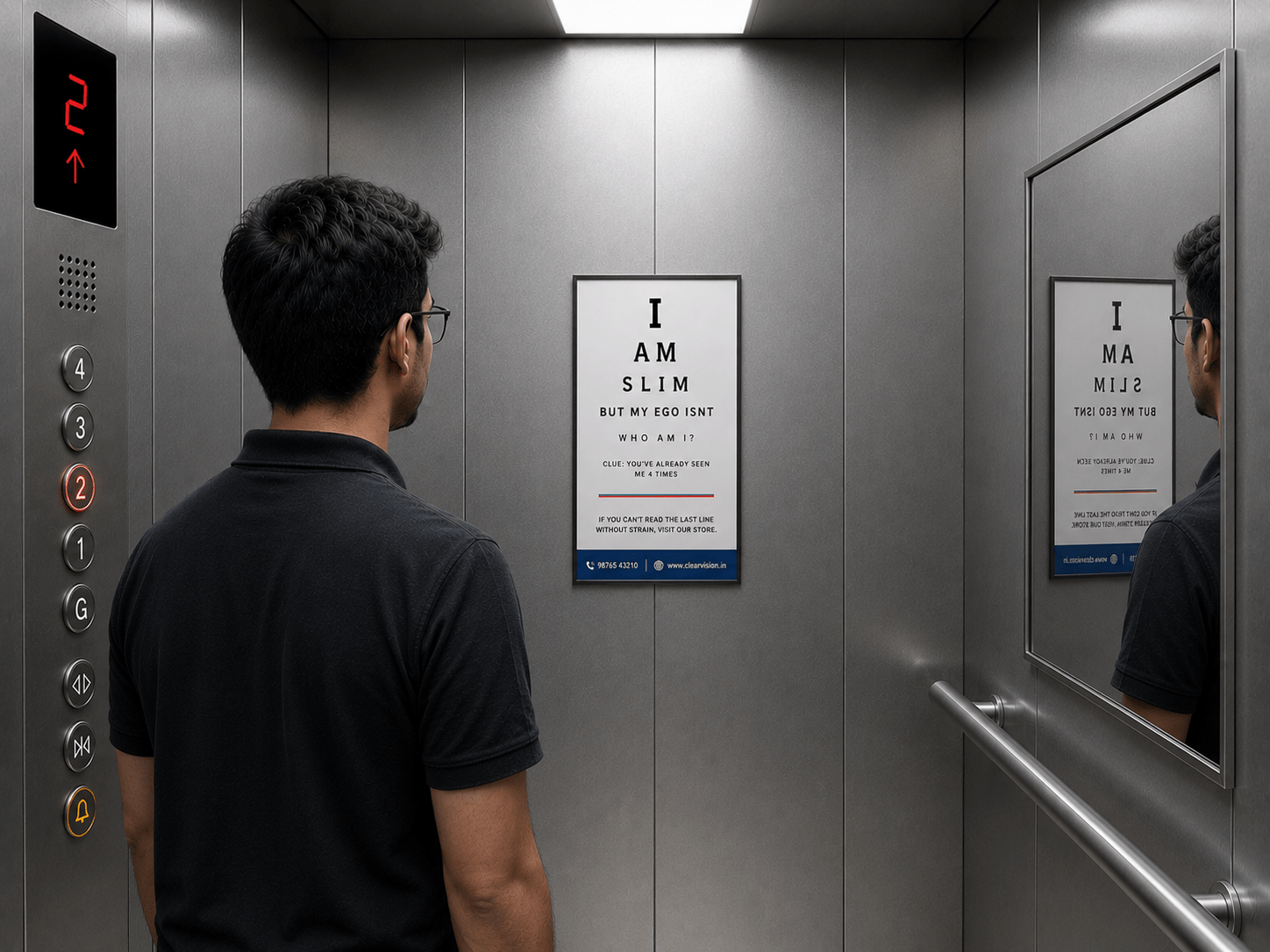
The average elevator ride lasts roughly 20 to 60 seconds. When trapped in a small metal box with strangers, people experience a strong subconscious need for visual distraction to avoid awkward eye contact.
Use this to your advantage. Place a Snellen eye chart that hides a secret word puzzle, riddle, or optical illusion inside the letters, you turn a passive wait into an interactive game. At the bottom of the poster, a sharp punchline reads: “If you can’t read the last three lines clearly, visit [Shop Name] today.”
Why this works?
Passengers are locked in a confined space with absolutely nothing to do. Your chart capitalises on this immediate boredom, and markets your shop.
-
- The “Aha!” Spike: When a passenger successfully cracks the hidden riddle or puzzle, their brain experiences a sudden flash of insight. This triggers a burst of dopamine, a harmone, which scientifically doubles memory retention and links a positive feeling to your brand.
- Subconscious Familiarity: Residents and office workers use the same lifts multiple times every single day. Even after solving the puzzle once, seeing your store’s name daily builds the “Mere Exposure Effect,” ensuring your shop is the first place they think of when they eventually need glasses.
- Subtle marketing: You make people realise that they are not able to read a line, this triggers an emotional corner of their space and motivated them to visit your shop. Offer a free eye test and also place in trend shades at eye level. They may either get a shade or an eyewear if necessary
2. The “Old Pair, New Pair” Exchange
Type: Reciprocity-Driven Promotion
What you need?
You’ll need:
- A storage box behind the counter, ensure they are not empty
- A fixed discount policy: 10% to 20% off the next purchase, decided by the condition of the old pair, so staff aren’t guessing or being inconsistent.
- A receipt system with a printed reference number and QR code of your isntagram account on every slip,. The customer requires to follow you and send a DM. That way, even if they lose the physical slip, you have a digital backup of both the number and the customer.
- A quarterly plan for the collected pairs (see below).
The Idea:
Most people have an old pair of glasses sitting in a drawer at home, unused, unloved, and completely forgotten. They don’t throw it away because it feels wasteful, but they also never think to bring it anywhere, because no one has ever given them a specific reason to.
So instead of waiting for someone to notice a sign, you train every staff member to simply ask, every single time a customer is in the store for any reason at all: “Do you have an old pair lying around? Bring it in anytime, any brand, any condition, and get 10 to 20% off your next pair.”
What happens to the old pairs afterward matters too, and there are two good uses for them, not one.
Frames in reasonable shape can go toward the Swap Day charity tie-up.
Frames that are too worn or outdated to donate still have working parts on them, screws, nose pads, hinges, temple tips, that your technician can strip and use for free or low-cost repairs on other customers’ frames.
Nothing you collect needs to go to waste.
Why this works?
-
- Reciprocity Triggered by a Person: A verbal offer from a real staff member creates a mild social obligation that a passive sign never does. People are far more likely to act on something they were personally asked, rather than something they were merely informed of.
- Removing Decision Fatigue: People don’t know what to do with old eyewear, so it just sits there. By handing them one specific, easy action and a clear number, 10 to 20%, you remove the friction that was stopping them from acting at all.
- The Endowment Effect in Reverse: Once a customer commits to bringing in their old pair, they’ve mentally started the process of replacing it. Walking in with the old pair in hand makes walking out with a new one feel like the natural next step, not a fresh decision.
- A Receipt System That Doubles as a Follow Ask: Asking customers to DM their receipt photo does two things at once. It protects them from losing a paper slip, and it gets them to follow your page, which means every redemption quietly grows your own audience as well. You also set a foundation for future social media promotions.
3. Free Vision Screenings at Gyms or Yoga Studios
Type: Co-Branded Wellness Activation combined with Contextual Priming.
What you need? You’ll need:
- A tie-up with 1–2 local gyms or studios, framed as a free member benefit.
- A portable screening kit: a basic chart and a few trial lenses, nothing clinical-grade required.
- A sign-up sheet or QR code for booking slots.
- A table styled to match the gym’s look, not a sales booth.
The Idea:
Someone who’s just finished a workout is already in a health-conscious frame of mind, they’re thinking about their body, their habits, their wellbeing. That’s a far more receptive moment for a vision-related suggestion than a random Tuesday afternoon. Set up a simple five-minute screening station inside the gym itself, positioned entirely as a free perk for members, not a sales visit, and let the gym itself promote it to its own audience.
Why this works?
-
- The Health Halo Effect: Once someone is already thinking “wellness,” almost any related health suggestion, including a vision check, gets accepted more readily than it would outside that mindset.
- Borrowed Trust: The gym’s endorsement of the event, simply by allowing and promoting it, transfers some of the trust members already have in their gym onto you.
- Low-Pressure Framing: Because there’s no product being pushed and no payment involved on the spot, people engage without their guard up, which builds more goodwill than a sales-forward pitch ever could in the same five minutes.
Rough cost:
₹0–3,000, mostly your time. Gyms rarely charge for this, since it adds value to their own membership without costing them anything.
4. The Blurry Vision Challenge
Type: Experiential Street Marketing combined with a Physical Proof Demonstration.
What you need?
You’ll need:
- A foldable table and two chairs, set up outside your store or another busy spot.
- 4–5 laminated challenge cards viewed through blur-simulating lenses (+1.00 to +3.00 works for people with normal vision).
- A basic Snellen chart printout.
- 2–3 demo frames for try-on photos.
- Printed “Free Eye Check-Up” coupons, valid for 14 days.
- One outgoing staff member to run it.
The Idea:
Set up a small table and dare passersby: “Bet you can’t read this from here.” They squint, they guess wrong, and then you flip in a corrective lens and watch the exact same text resolve into something perfectly readable. That flip, right in front of them, is the entire sales pitch. You never had to claim your store fixes blurry vision, they just watched it happen to their own eyes. Once the surprise lands, hand them a coupon for a free comprehensive eye check-up, not a trinket, so there’s a real reason to come back through your door.
Why this works?
-
- Proof Beats Persuasion: A felt, physical demonstration of a problem being solved bypasses the usual skepticism people have toward advertising claims, because they experienced it themselves rather than being told about it.
- The Curiosity Gap: A dare stops far more people than an invitation does. “Bet you can’t” triggers a small competitive itch that “come try our test” never will.
- A Coupon With a Funnel: A free check-up isn’t a giveaway that gets pocketed and forgotten, it’s an appointment waiting to be booked, and it’s during that appointment that your optician naturally gets a real shot at recommending frames or lenses.
5. Adopt-a-Frame at a Local School
Needs a real budget and an ongoing relationship with the school.
Donate a batch of refurbished or heavily discounted glasses to students who need them, and ask the school for a small hallway credit in return, a plaque or a simple banner with your store’s name.
Get ten to twenty pairs ready, then approach the school’s admin or PTA as a genuine donor first. Ask about the credit only after the donation itself is agreed, so it doesn’t feel like a trade. Photograph the handover with everyone’s consent, and most schools will happily share it in their own newsletter or parent group without you having to ask twice.
The trust a school already has with parents carries over to you here, which is worth far more than an ad could ever buy.
Cost: Use the stock you’ve collected in the old pair, new pair eyewares, refurbish and polish them toensure that they look new.
Suggested Rollout
Start with the QR-code posters and the Old Pair, New Pair exchange in the same week, since neither needs a partner or a budget, and the exchange also starts building the stock of collected frames you’ll need later. Once those are running quietly, bring in the gym screenings, that just takes a short conversation with a local gym owner, and once you’ve got a rhythm going, add the Blurry Vision Challenge on weekends when you have a staff member free with some energy to spare.
Save the school program for last. By then, the Old Pair, New Pair exchange should have already built up a stock of collected frames behind your counter, so refurbish and polish those instead of buying new pairs for the donation, which brings the cost down close to nothing.
Conclusion
An opening event and a signboard get you noticed once. What keeps a store running is a steady supply of creative marketing ideas for optical stores that give people an actual reason to walk in, not just tell them you exist. The ten ideas here start with almost no cost, a poster, a script, a conversation with a gym owner, and build up to ones that take real planning, like the school program. None of them need a big ad spend, they just need you to create small, real moments people remember and talk about.
If you’re still looking around for more optical store marketing ideas beyond these, the pattern to follow is the same one running through all ten: give people something to feel, something to talk about, or someone they already trust to hear it from, instead of another banner asking them to walk in. Pick two or three that suit where your store is right now, get them running well, and add the rest as you go. That’s what turns a store that’s simply open into one that people actually choose.

